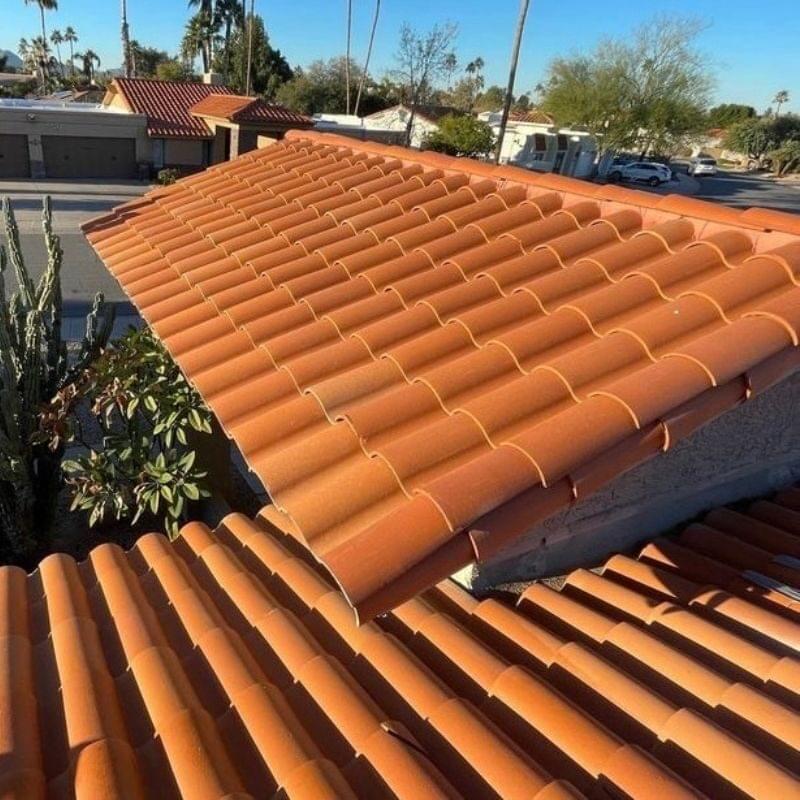
How to Choose a Roofing Contractor in San Diego (2026 Homeowner's Guide)
Hiring the wrong roofer is the most expensive mistake a San Diego homeowner can make. A bad install shows up three winters later — leaks at valleys, lifted tile in a Santa Ana, mold in the attic — and by then the "contractor" has changed names, lost their license, or left the state. This guide is the exact 12-point checklist we tell our own friends and family to use when hiring any San Diego roofing contractor — including us.
1. Verify the CSLB license (before anything else)
California requires a C-39 Roofing Contractor license for any roofing job over $500. Go to cslb.ca.gov, search the company name, and confirm the license is active, has a C-39 classification, the bond is current, and there are no unresolved complaints. California First Roofing holds CSLB #1094851 — verify us in 30 seconds. If a contractor can't give you a license number, walk away.
2. Confirm workers' comp and general liability insurance
Ask for a Certificate of Insurance sent directly from the carrier — not a PDF from the contractor. It must list your address as certificate holder and show at least $1M general liability and active workers' comp. Without workers' comp, if a roofer falls off your house, you are liable.
3. Look for factory certifications, not stickers
Manufacturers like GAF, Owens Corning, CertainTeed, Boral, Eagle, Malarkey, Polyglass, and Carlisle audit their certified installers. A GAF Master Elite or Owens Corning Platinum Preferred badge means the contractor has been inspected and cleared to offer the manufacturer's 50-year system warranty — a warranty a non-certified roofer legally cannot sell you.
4. Understand the two warranties you're buying
- Material warranty — from the manufacturer, covers defects (30–50 years, often prorated).
- Workmanship warranty — from the contractor, covers install error (2–25 years). A 2-year warranty from a small crew is a very different product than a 25-year non-prorated system warranty from a factory-certified installer.
5. Demand a line-item proposal — never a lump sum
A real San Diego roofing estimate includes: tear-off scope, decking replacement rate per sheet, synthetic underlayment brand and weight, ice-and-water shield placement, valley metal gauge and finish, flashing specification, ventilation calculation, dumpster and haul-off, and permit cost. "$28,000 — new roof" tells you nothing.
6. Get three bids — but not the cheapest, and not the most expensive
Roofing bids in San Diego typically vary by 25–40% for the same home. The lowest bid almost always cuts underlayment, flashing, or crew. The highest is often a national chain paying commission overhead. The right bid is the middle one with the strongest warranty and the clearest scope.
7. Ask who is actually on your roof
W-2 employees or subcontracted day-labor? W-2 crews are trained, insured under the company's workers' comp, and accountable to the license holder. Subcontracted crews rotate between companies and disappear when there's a callback.
8. Read Google reviews the right way
Ignore the star average. Read the 2- and 3-star reviews — they tell you how the contractor handles problems. A contractor with 500 five-star reviews and zero complaints has been buying reviews. A 4.9 average with a handful of 2-star reviews responded to professionally, refunded, and fixed — that's who you want.
9. Verify they pull the permit — in your name
Every re-roof in the City of San Diego and unincorporated San Diego County requires a permit. If a contractor offers to skip it to save you money, they are protecting themselves from the inspection — your insurance can deny future claims on unpermitted work.
10. Ask about Title 24 and cool-roof compliance
California Title 24 Part 6 requires cool-roof-rated materials on most re-roofs in climate zones 10–15 (all of San Diego County). A real contractor will know your zone off the top of their head and spec CRRC-listed products.
11. Verify local address and physical office
Storm chasers rent PO boxes. A real San Diego roofing contractor has a physical address, a truck yard, and material in stock. California First Roofing is at 9606 Tierra Grande St, San Diego, CA 92126 — come by.
12. Trust the paperwork, not the pitch
Ignore the pressure and "today only" pricing. Read the contract. Confirm the material brand and model, warranty duration, workmanship term, payment schedule (never more than 10% down in California — it's the law), and completion date. If those four things are correct on paper, you have hired well.
Red flags that end the conversation
- Door-knocking after a storm
- Deposit requests over 10% of the contract price
- Cash-only or discount-for-cash pricing
- No physical address on the proposal
- Pressure to sign "today" for a discount
- Offering to "eat the deductible" on an insurance claim (fraud in California)
- No permit, or "we'll pull it later"
The California First Roofing standard
CSLB #1094851, $2M general liability, full workers' comp, and factory certifications with GAF, Owens Corning, CertainTeed, Boral, Eagle, Malarkey, Polyglass, and Carlisle. Every estimate is a fixed-price, line-item proposal delivered with a drone survey, decking assessment, and photo documentation. Every roof is installed by W-2 employees and permitted through the local AHJ.
Ready for an estimate you can actually compare?
Call (424) 777-1619 or email sales@californiafirstroofing.com. Serving all of San Diego County: La Jolla, Rancho Santa Fe, Del Mar, Carlsbad, Encinitas, Poway, Coronado, Point Loma, Chula Vista, El Cajon, Escondido, and every neighborhood in between.
Frequently Asked Questions
How do I choose a roofing contractor in San Diego?
Verify CSLB C-39 license, workers' comp and general liability, factory certifications (GAF Master Elite, Owens Corning Preferred), 50+ verified local reviews, and a physical San Diego address. Get written scopes, not just totals.
What license does a roofing contractor need in California?
A CSLB C-39 (Roofing) license — not just a general B contractor's license. Verify it at cslb.ca.gov before signing. California First Roofing holds CSLB #1094851 with active workers' comp and $2M general liability.
Should I always get three roofing estimates?
Yes — but compare scope, not just price. The cheapest estimate usually cuts underlayment grade, nail count, or flashing metal. Ask each contractor to bid the same detailed specification so quotes are actually comparable.
What warranties should a roofing contractor offer?
A quality contractor stacks two warranties: the manufacturer's material warranty (25–50 years on shingles, 50+ on tile) and their own workmanship warranty (10–25 years). Factory-certified installers can offer enhanced manufacturer warranties like GAF Golden Pledge.
Ready for a Free Estimate?
Talk to a senior consultant today. On-site assessment, drone imagery, transparent pricing.